Introduction
In machine learning, there are broadly two classes of models: discriminative, and generative. Discriminative models take data (observations), and produce predictions. Generative models work by learning the distribution that produced the data, and using it to generate new samples. To be more precise, given observations $x$ and predictions $y$, a discriminative model seeks to learn $p(y|x)$, while a generative model seeks to learn $p(x)$.
In this post I’ll explore one type of generative model, the variational autoencoder (VAE), first introduced by Kingma and Welling. VAEs are particularly suited to problems where the observed data is believed to be generated by an underlying set of unobserved latent variables — structure that is real but not directly measurable. The VAE addresses this by learning two things jointly: an encoder that maps observations to a distribution over latent variables, and a decoder that maps latent variables back to the data space. Together these give us both a generative model and a structured latent representation of the data.
To build intuition for the loss function and training procedure, we’ll apply a VAE to a synthetic dataset generated by a known process — points on a 2D spiral with additive noise. Having access to the true underlying process lets us verify that the model is learning something meaningful, and explore how architectural choices affect the result. The code used for this post can be found here.
Variational Autoencoders
Let’s start by breaking down what the name implies about VAEs. They are “variational” because they seek to solve a variational Bayes problem – to learn approximate representations of the posterior probability $p(z|x)$ for some latent variables $z$, and to learn a lower bound on the evidence (aka marginal likelihood) $p(x)$ over observations $x$. They are “autoencoders” because they have the classic encoder-decoder structure. However, unlike a traditional autoencoder that maps each observation $x$ to a single point $z$ in latent space, a VAE maps each observation to a distribution $q_\phi(z|x)$ over latent variables.
There are some assumptions about the process being modeled that are important to keep in mind. The dataset $X = \{ x^{(i)}\}_{i=1}^{N}$ is assumed to consist of $N$ i.i.d samples of a discrete or continuous variable $x$. The latent variables $z$ are assumed to be continuous.
We can think of the underlying process as consisting of 2 steps:
- A latent variable $z^{(i)}$ is sampled from a prior distribution $p_{\theta^*}(z)$.
- A value $x^{(i)}$ is produced by sampling the conditional distribution $p_{\theta^*}(x|z)$.
The prior $p_{\theta^*}(z)$ and likelihood $p_{\theta^*}(x|z)$ are assumed to belong to parametric families of distributions $p_{\theta}(z)$ and $p_{\theta}(x|z)$, and the hope is that the paramaters $\theta$ that will be learned during training will be a good approximation to the true values $\theta^*$.
More formally, we will have an encoder $q_\phi(z|x)$, also referred to as the recognition model. Given an observation $x$, we can sample from $q_\phi$ to generate a latent representation $z$. The decoder, $p_\theta(x|z)$ takes a latent representation $z$, and produces new observations $x$.
The Variational Lower Bound (ELBO)
Remember that the goal of variational Bayes is to learn $p(x)$ by maximizing the marginal likelihood over observations. Because the VAE framework assumes datapoints are i.i.d, the log marginal likelihood over the data is $\log p_\theta(x^{(1)},...,x^{(N)}) = \sum_{i=1}^N \log p_\theta(x^{(i)})$. To relate the encoder to the likelihood, there are a number of approaches. I like this approach following Kingma and Welling’s longer introduction to VAEs:
$$ \begin{eqnarray} \log p_\theta(x) &=& \mathbb{E}_{q_\phi(z|x)}[\log p_\theta(x)] \nonumber \\ &=& \mathbb{E}_{q_\phi(z|x)}\left[\log\left[\frac{p_\theta(x,z)}{p_\theta(z|x)}\right]\right] \nonumber \\ &=& \mathbb{E}_{q_\phi(z|x)}\left[\log\left[\frac{p_\theta(x,z)}{q_\phi(z|x)}\frac{q_\phi(z|x)}{p_\theta(z|x)}\right]\right] \nonumber \\ &=& \mathbb{E}_{q_\phi(z|x)}\left[\log\left[\frac{q_\phi(z|x)}{p_\theta(z|x)}\right]\right]+ \mathbb{E}_{q_\phi(z|x)}\left[\log\left[\frac{p_\theta(x,z)}{q_\phi(z|x)}\right]\right] \nonumber \\ &=& D_{KL}(q_\phi(z|x)||p_\theta(z|x)) + \mathcal{L}(\theta, \phi; x) \end{eqnarray} $$The term $D_{KL}(q_\phi(z|x)||p_\theta(z|x)) \equiv \mathbb{E}_{q_\phi(z|x)}\left[\log q_\phi(z|x) - \log p_\theta(z|x) \right]$ is the Kullback-Leibler (KL) divergence – a function that is strictly non-negative, and equals zero only when $q_\phi(z|x) = p_\theta(z|x)$. The second term is called the variational lower bound, or evidence lower bound (ELBO), since the non-negativity of $D_{KL}$ ensures that
$$ \begin{eqnarray} \mathcal{L}(\theta, \phi; x) &=& \log p_\theta(x) - D_{KL}(q_\phi(z|x)||p_\theta(z|x)) \\ &\le& \log p_\theta(x) \end{eqnarray} $$The form we have written $\mathcal{L}$ makes it clear that it is a lower bound on our quantity of interest $p_\theta(x)$, and that maximizing $\mathcal{L}$ will tend to pull $q_\phi(z|x)$ towards $p_\theta(z|x)$. However, the current form doesn’t help us actually maximize the ELBO, since it depends on the intractable true posterior $p_\theta(z|x)$. Let’s see if we can eliminate that dependence:
$$ \begin{eqnarray} \mathcal{L}(\theta, \phi; x) &=& \log p_\theta(x) - D_{KL}(q_\phi(z|x)||p_\theta(z|x)) \nonumber \\ &=& \log p_\theta(x) - \mathbb{E}_{q_\phi(z|x)}\left[\log q_\phi(z|x) - \log p_\theta(z|x) \right] \nonumber \\ &=& \mathbb{E}_{q_\phi(z|x)}\left[\log p_\theta(x) - \log q_\phi(z|x) + \log p_\theta(z|x) \right] \nonumber \\ &=& \mathbb{E}_{q_\phi(z|x)}\left[-\log q_\phi(z|x) + \log p_\theta(z,x) \right] \nonumber \\ &=& \mathbb{E}_{q_\phi(z|x)}\left[-\log q_\phi(z|x) + \log p_\theta(x|z) + \log p_\theta(z) \right] \nonumber \\ \label{eq:ELBO} &=& -D_{KL}(q_\phi(z|x)||p_\theta(z)) + \mathbb{E}_{q_\phi(z|x)}\left[ \log p_\theta(x|z) \right] \end{eqnarray} $$We now have almost everything we need to optimize our system. The ELBO is composed of two terms. The first term depends on the encoder $q_\phi(z|x)$, and the second term depends on the decoder $p_\theta(x|z)$. We would like to parameterize the encoder and decoder using neural networks and optimize $\theta$ and $\phi$ via gradient descent. However, there is one problem remaining.
A Roadblock for Optimization
To really understand the problem, let’s take a step back and think about what we’ve accomplished so far, and what an implementation of VAE training might look like. Recall that we are assuming $q_\phi(z|x)$, $p_\theta(z)$, and $p_\theta(x|z)$ all belong to families of distributions that can be parameterized. Let’s be more explicit now, and assume
$$ \begin{equation} \label{eq:encoder_model} q_\phi(z|x) \sim \mathcal{N}\left(\mu_\phi(x), \sigma^2_\phi(x) \right) \end{equation} $$$$ \begin{equation} \label{eq:decoder_model} p_\theta(x|z) \sim \mathcal{N}\left(\mu_\theta(z), \sigma^2_\theta(z) \right) \end{equation} $$$$ \begin{equation} p_\theta(z) \sim \mathcal{N}\left(0, I \right) \end{equation} $$In other words, we are assuming multivariate Gaussian distributions with zero covariance. We are going to learn $\mu_\phi(x)$ and $\sigma_\phi(x)$ through a neural network (the encoder), and $\mu_\theta(z)$ and $\sigma_\theta(z)$ through another neural network (the decoder). The loss will be composed of 2 terms, according to equation \ref{eq:ELBO}.
The first term, given the choice of normal distribution families, can be expressed analytically as
$$ \begin{equation} \label{eq:dkl_exact} D_{KL}(\mathcal{N}\left(\mu_\phi(x), \sigma_\phi(x) \right)||\mathcal{N}\left(0, I \right)) = -\frac{1}{2} \sum_{j=1}^J\left( 1 + \log\left((\sigma_\phi(x)_j)^2\right) - (\mu_\phi(x)_j)^2 - (\sigma_\phi(x)_j)^2 \right) \end{equation} $$where $J$ is the dimension of $z$, and $\sigma_\phi(x)_j$ is the $j^{th}$ component of $\sigma_\phi(x)$ (and similarly for $\mu$). This term is perfect, we have an analytical form for the loss and can easily use gradient descent to optimize $\phi$.
The second term, commonly referred to as the reconstruction loss, is now
$$ \begin{equation} \label{eq:reconstruction_exact} \mathbb{E}_{q_\phi(z|x)}\left[\log\left( \mathcal{N}\left(\mu_\theta(z), \sigma_\theta(z) \right)\right) \right] \approx \frac{1}{L}\sum_{l=1}^L \log \left( \mathcal{N}\left(\mu_\theta(z^{(l)}), \sigma_\theta(z^{(l)}) \right) \right) \end{equation} $$where the sum is over $L$ instances of $z$ sampled from $\mathcal{N}\left(\mu_\phi(x), \sigma_\phi(x) \right)$. This term is problematic, because sampling is a non-differentiable operation that we cannot backpropagate through. And that brings us to the reparameterization trick.
The Reparameterization Trick
To optimize the ELBO we need to backpropagate gradients through both terms with respect to $\phi$ and $\theta$. The first term (KL divergence) is straightforward to differentiate, as discussed previously, but the second term (reconstruction loss) is problematic. Estimating it requires sampling $z \sim q_\phi(z|x)$, and sampling is a non-differentiable operation: there is no well-defined gradient of a sample with respect to the distribution’s parameters $\phi$. Gradients can’t flow backward through a stochastic node, which means we cannot directly optimize $\phi$ in the reconstruction term.
The reparameterization trick resolves this by restructuring where in the network the stochasticity lives. Rather than sampling $z$ directly from $q_\phi(z|x)$, we introduce an auxilliary random variable $\epsilon \sim p(\epsilon)$ that is independent of $\phi$, and express $z$ as a deterministic function of $\epsilon$ and $x$:
$$ \begin{equation} z = g_\phi(\epsilon, x) \end{equation} $$It then follows from the change of variables theorem that
$$ \begin{equation} \mathbb{E}_{q_\phi(z|x)}[f(z)] = \mathbb{E}_{p(\epsilon)}[f(g_\phi(\epsilon,x))] \end{equation} $$The two expectations are equivalent, but the right-hand side has the crucial property that $\phi$ only enters through the deterministic, differentiable function $g_\phi$, while the randomness is isolated in $\epsilon$. Gradients can now flow through $g_\phi$ using standard automatic differentiation.
For the Gaussian case we’ve been discussing, where $q_\phi(z|x) \sim \mathcal{N}(\mu_\phi(x), \sigma_\phi(x))$, the reparameterization takes a particularly simple form:
$$ \begin{equation} z = \mu_\phi(x) + \sigma_\phi(x) \cdot \epsilon, \quad \epsilon \sim \mathcal{N}(0,I) \end{equation} $$The encoder network outputs $\mu_\phi(x)$ and $\sigma_\phi(x)$, and $z$ is computed from them via this deterministic expression. The stochastic node has been replaced by a deterministic one, with the randomness pushed to an input $\epsilon$ that requires no gradient. The full model is now end-to-end differentiable.
The Data
We’re going to work through building and training a VAE on a 2D spiral dataset with additive noise. The 2D spiral is a great test case because it’s just complex enough to be non-trivial to train a model on, but simple enough that we can develop a complete Bayesian model of the process. It’s also a breeze to visualize.
The easiest way to think about generating a spiral is to use polar coordinates. To generate a spiral, increase the polar angle $\theta$ linearly in time with rate $\omega$, and increase the radius $r$ linearly at rate $\dot{r}$. So, in polar coordinates, the spiral is parameterized by a single value $t$ according to $(r(t), \theta(t)) = (\dot{r}t,\omega t)$. Using basic trigonometry , we can re-write the equations in terms of the Cartesian coordinates $(x,y)$. Adding isotropic Gaussian noise, we arrive at the spiral random variables we wish to study:
$$ \begin{eqnarray} \label{eq:xt} x(t) &=& \dot{r}t\cos(\omega t) + \epsilon_x \\ \label{eq:yt} y(t) &=& \dot{r}t\sin(\omega t) + \epsilon_y \\ \end{eqnarray} $$where $\epsilon_x,\epsilon_x \sim \mathcal{N}(0,\sigma_{data}^2)$. The parameter $t$ serves as the latent variable $z$, and I’ll use $z$ and $t$ interchangeably. We’ll generate our data for values $t \in [0,1]$.
Let’s think about the Bayesian model for this process. The process fits naturally into the two-step generative framework introduced earlier:
- A latent variable $t$ is sampled (let’s say from the uniform distribution).
- A value $(x, y)$ is produced by sampling from a conditional distribution $p_\theta(x,y|z)$.
The distribution $p_\theta(x,y|z)$ also deserves some more attention. Without the latent variable, $x$ and $y$ are dependent variables (just think about the distribution of $y$ for a fixed $x$ where the spiral crosses vs. an $x$ far from a crossing). However, once the latent variable $t$ has been specified, $x(t)$ and $y(t)$ are independent random variables since $\epsilon_x$ and $\epsilon_y$ are independent. That means $x$ and $y$ are independent conditioned on $t$, so $p_\theta(x,y|z) = p_\theta(x|z) p_\theta(y|z)$, which is precisely what makes the latent variable useful. Using equations \ref{eq:xt}, \ref{eq:yt},
$$ \begin{equation} p_\theta(x,y|z=t) = \mathcal{N}(\dot{r}t\cos(\omega t), \sigma_{data}^2) \cdot \mathcal{N}(\dot{r}t\sin(\omega t), \sigma_{data}^2) \end{equation} $$In other words, the variance in our generative model $p_\theta(x,y|z)$ is a constant, equal to $\sigma^2_{data}$. This property of our data model – that the observation noise is constant and known – will directly inform our choice of decoder, which we discuss in the next section.
Implementation
With the basic mechanisms of VAEs squared away, and a dataset specified, it’s finally time to implement a VAE. All of the code is available here.
Model
Encoder
We are modeling the encoder as being a member of a Gaussian distribution with mean and variance that depend on the input $x$ (equation \ref{eq:encoder_model}). We can implement the encoder as a simple MLP.
class SpiralEncoder(nn.Module):
    """
    Encode 2D spiral data points encoded according to recognition model
    q_phi(z|x). q_phi(z|x) is assumed normal, and the encoder predicts
    the mean and log variance per data point x.
    """

    def __init__(self, latent_dims=1, hidden_dim=32, hidden_layers=1):
        super().__init__()
        self.latent_dims = latent_dims
        self.hidden_dim = hidden_dim
        self.hidden_layers = hidden_layers
        layers = [nn.Linear(2, hidden_dim), nn.Tanh()]
        for _ in range(hidden_layers - 1):
            layers += [nn.Linear(hidden_dim, hidden_dim), nn.Tanh()]
        self.h = nn.Sequential(*layers)
        self.linear_mu = nn.Linear(self.hidden_dim, self.latent_dims)
        # mlp_sigma predicts the log variance, not the variance or std
        self.linear_sigma = nn.Linear(self.hidden_dim, self.latent_dims)

    def forward(self, x):
        h = self.h(x)
        mu = self.linear_mu(h)
        sigma = self.linear_sigma(h)
        return mu, sigma
The encoder takes in a data point $\mathbf{x} = (x,y)$, and produces two outputs,
$\mu_\phi(\mathbf{x})$, $\log\sigma^2_\phi(\mathbf{x})$. The model is assumed to
output log variance for numerical stability. The default latent_dims=1
reflects our data model, where a single parameter $t$ generates each
observation. The hidden_dim=32 and hidden_layers=1 work for simple spiral
data.
Reparameterization Trick
The encoder gives us the predictions for $\mu_\phi(\mathbf{x})$, $\log\sigma^2_\phi(\mathbf{x})$. Next, we need to generate a sample latent variable from $\mathcal{N}(\mu_\phi(\mathbf{x}), \sigma^2_\phi(\mathbf{x}))$. Remember, this is where the reparameterization trick is needed, so that gradients can flow back through the encoder.
def reparam(mu, logsigma):
    """
    Reparamaterization trick to backprop through sampling q_phi(z|x).
    mu, logsigma are the outputs of the encoder. logsigma is treated
    as being log (sigma^2).
    """
    samples = torch.randn_like(logsigma)
    sigma = torch.exp(0.5 * logsigma)
    return mu + sigma * samples
The randomness is isolated in torch.randn_like(logsigma), which has no
dependence on $\phi$, while $\phi$ enters through mu and logsigma via
oridinary differentiable operations.
Decoder
The decoder is being modeled as a Gaussian distribution, just like the encoder, according to equation \ref{eq:decoder_model}. But based on the system we’re modeling, there’s an important design consideration to address in the decoder. Recall that for our spiral data, we found that the variance for the generative model $p_\theta(x,y|z)$ was constant, with a value $\sigma^2_{data}$. Since we know the variance is constant, we’ll leave it out of the decoder MLP, and instead opt to set it manually as a parameter of the reconstruction loss. With this simplification in mind, here is an implementation of the decoder:
class SpiralDecoder(nn.Module):
    """
    Decode 2D spiral data points from latent variable z according to a
    generative model p_theta(x|z). p_theta(x|z) is assumed to be normal
    with mu per latent instance z and variance fixed. In other words, the
    model simply outputs mu_theta(z) due to our assumptions.
    """

    def __init__(self, latent_dims=1, hidden_dim=32, hidden_layers=1):
        super().__init__()
        self.latent_dims = latent_dims
        self.hidden_dim = hidden_dim
        self.hidden_layers = hidden_layers
        layers = [nn.Linear(self.latent_dims, hidden_dim), nn.Tanh()]
        for _ in range(hidden_layers - 1):
            layers += [nn.Linear(hidden_dim, hidden_dim), nn.Tanh()]
        layers += [nn.Linear(hidden_dim, 2)]
        self.mlp = nn.Sequential(*layers)

    def forward(self, z):
        return self.mlp(z)
The variable latent_dims=1 is set independently on the decoder, but it must
match whatever value is used in the encoder. The output dimension is hard-coded
to 2 since we are reconstructing 2D points.
Loss
The KL loss term can be written out analytically according to equation \ref{eq:dkl_exact}, where we have assumed the prior of over $z$ is a standard normal. The reconstruction loss is worth a closer look now that we have solidified our assumptions about the data.
def KL_loss(mu, logsigma):
    """
    mu: encoder predicted mu_phi(z|x)
    logsigma: encoder predicted log(sigma_phi(z|x)^2)
    """
    sigma_squared = logsigma.exp()
    per_dim = 0.5 * (1 + logsigma - mu**2 - sigma_squared)
    per_datapoint = per_dim.sum(dim=1)
    return -per_datapoint.mean()
Notice the implementation differs by a minus sign from the corresponding term in the ELBO. This is because the ELBO is a lower bound, but in normal gradient descent we are attempting to minimize the loss function. The same sign change appears in the reconstruction term.
Recall the functional form of the reconstruction loss follows equation \ref{eq:reconstruction_exact}. The expectation value is estimated by a sample mean over $L$ points, and is the log of a normal distribution with parameters $\mu_\theta(z^{(l)})$, $\sigma_\theta(z^{(l)})$. We will follow the common practice of setting $L = 1$ and use the single latent variable sampled by the encoder. The term $\sigma_\theta(z)$ needs to be considered carefully.
As discussed in the previous section, our data generation model has a fixed variance $\sigma^2_{data}$, so having the decoder learn $\sigma_\theta(z)$ would add unnecessary complexity. Assuming a fixed $\sigma_\theta(z) = \sigma$, the reconstruction loss can now be expressed explicitly as
$$ \begin{eqnarray} \frac{1}{L}\sum_{l=1}^L \log\left( \mathcal{N}\left(\mu_\theta(z^{(l)}), \sigma_\theta(z^{(l)}) \right) \right) &=& \log \mathcal{N}\left(\mu_\theta(z), \sigma)\right) \nonumber \\ \label{eq:reconstruction_loss_sigma} &=& -\frac{1}{2\sigma^2}\sum_{i=1}^{D}(x_i - \mu_\theta(z)_i)^2 - \frac{D}{2}\log\left(2\pi\sigma^2 \right) \\ &=& -\frac{1}{2\sigma^2}||x - \mu_\theta(z)||^2 + const \end{eqnarray} $$where the sum $i$ is over the dimensions, of which there are $D$ ($D = 2$ in our case). This means the reconstruction loss boils down to an MSE loss, since any additive constant will drop out in the gradient and can be dropped. Also note that the constant term is only constant and dropped under the current assumption that $\sigma$ is a set constant.
def reconstruction_loss(x, mu, sigma=1.0):
    per_dim = (x - mu) ** 2
    per_datapoint = per_dim.sum(dim=1)
    return per_datapoint.mean() / (2 * sigma**2)
The parameter sigma in the reconstruction loss now controls the relative
weighting of the reconstruction and KL loss terms: smaller values weight
reconstruction more heavily, larger values give more weight to the KL term. The
relationship between $\sigma$ and the data generating process is discussed in
the results.
Results
To train a model, I generated 200 data points with $\sigma^2 = \sigma^2_{data} = 0.2$, where $\sigma^2$ is the fixed variance of the decoder. I kept the default encoder and decoder parameters mentioned earlier – a single hidden layer with 32 neurons. Training was done for 20,000 epochs with an Adam optimizer with learning rate set to $1 \times 10^{-3}$.
To assess the VAE, I’m looking at 3 things:
- The structure of the latent space.
- The reconstruction of the data points that results from a forward pass through the VAE.
- Newly generated samples produced by feeding latent samples $z \sim \mathcal{N}(0,1)$ into the decoder.
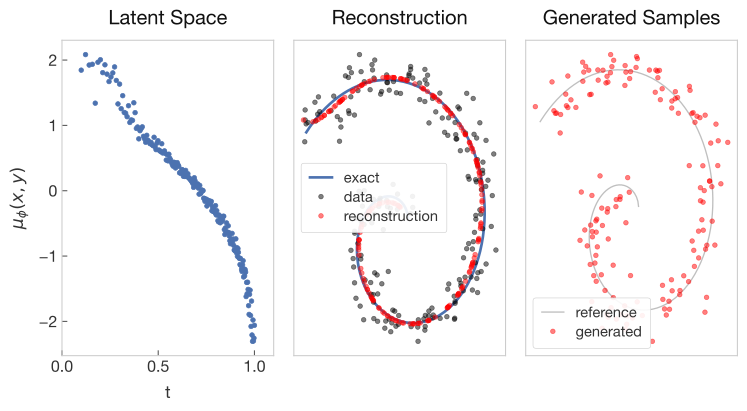 Left: Latent space learned by VAE encoder. Center: Reconstruction of underlying
spiral from training data, with the exact generating model shown for comparison.
Right: New samples produced by the decoder, with the exact spiral shown for
reference.
Left: Latent space learned by VAE encoder. Center: Reconstruction of underlying
spiral from training data, with the exact generating model shown for comparison.
Right: New samples produced by the decoder, with the exact spiral shown for
reference.
The three panels of the results collectively demonstrate the VAE has learned a meaningful latent representation of the dataset, can reconstruct the manifold, and can generate new plausible samples.
The left panel of the results is showing the structure of the latent space. For each data point from the training set $\mathbf{x} = (x,y)$, we can use the encoder to predict the value of the latent variable $t$. Since we know the true value of the latent variable that was used to generate the data, we should hope that a plot $\mu_\phi(\mathbf{x})$ against $t$ should be smooth, and somewhat linear, and that is precisely what we see! Notice that near $t=0$, there appears to be a bit more noise. We know that points near the origin have small $r$, so $(x,y)$ points are close together regardless of $t$, making it harder for the encoder to assign a unique $t$ to each point. This difficulty in assigning a unique $t$ becomes fundamental if we were to generate a spiral with multiple revolutions. Inverting equations \ref{eq:xt} and \ref{eq:yt} of the data generating process for $t$ leads to the equation $\omega t = \tan^{-1}(y/x)$, which is only defined modulo $2\pi$. So, a point $(x,y)$ with $y=0$, for example, is equally consistent with $\omega t = 0, 2\pi, 4\pi,...$ The encoder has no way to resolve which revolution a point belongs to, and our model with a single latent variable would be misspecified.
The center panel shows how well the VAE can reconstruct the underlying spiral structure from the noisy data points. The training data are shown in gray, and the output of the VAE is in red. You may be wondering why the reconstruction doesn’t have the noise of the data. Remember that the output of the VAE is predicting $\mu_\theta(z)$ (the mean values of $\mathbf{x}$), and we have assumed a fixed variance. The right panel takes the final step, asking whether the model is truly generative.
In the right panel, we are generating new samples from the generative model. Since the KL loss term is pulling the recognition model $q_\phi(z|x)$ to match the latent space prior $p_\theta(z) = \mathcal{N}(0,1)$, if the model has trained successfully, we can generate samples with the following procedure:
- Sample latent values from a $\mathcal{N}(0,1)$.
- Feed latent values through the decoder
- Use the output of the decoder to sample data points from $\mathcal{N}(\mu_\theta(z), \sigma^2)$, where again, $\sigma^2$ is the fixed isotropic variance that we are setting manually to match the variance in the data.
It is clear that the samples generated from this procedure mimic the true data excellently.
In training this model, we had the luxury of knowing the underlying process, and we set $\sigma^2 = \sigma^2_{data}$ accordingly. In a real application, we probably won’t know what the true value of $\sigma_{data}$ is.
What if $\sigma$ is Chosen Wrong?
So what happens during training if we pick a value for $\sigma$ that doesn’t match the true process?
To study what might happen in practice, the system from the previous section was run with $\sigma$ varied. The only other change I made was to add one additional hidden layer to the encoder and decoder so the model has at some capacity to overfit.
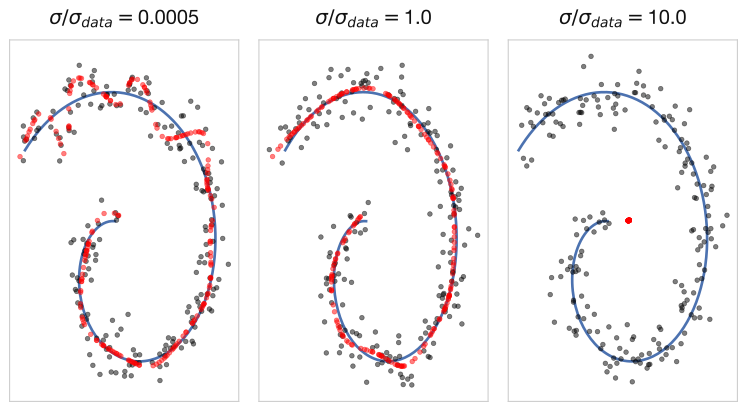 Left: Model overfitting when $\sigma \ll \sigma_{data}$. Center: Successful
training when $\sigma = \sigma_{data}$. Right: Posterior collapse
when $\sigma \gg \sigma_{data}$.
Left: Model overfitting when $\sigma \ll \sigma_{data}$. Center: Successful
training when $\sigma = \sigma_{data}$. Right: Posterior collapse
when $\sigma \gg \sigma_{data}$.
To get a sense of what’s happening, let’s examine our loss function with the current assumptions ($\sigma$ fixed, Gaussian distributions), which has the functional form:
$$ \begin{equation} loss = \frac{1}{2\sigma^2}||x - \mu_\theta(z)||^2 + D_{KL} \end{equation} $$The term $\sigma^2$ can be thought of as a weighting factor, that biases the loss function more towards reconstruction when $\sigma^2$ gets smaller, and more towards $D_{KL}$ when $\sigma^2$ gets bigger. Since the reconstruction term penalizes the loss when the output doesn’t match the input, we should expect that when $\sigma \ll \sigma_{data}$, the model is prone to overfitting the training data, and we can see evidence of this in the left panel, where $\sigma/\sigma_{data} = 0.0005$. A model with more parameters would likely fit even more dramatically to the noise.
When $\sigma \gg \sigma_{data}$, the model prioritizes minimizing $D_{KL}$, which is trying to pull the encoder’s distribution $q_\phi(z|x)$ to match the latent prior, $\mathcal{N}(0,1)$. The expected result is a latent space that resembles $\mathcal{N}(0,1)$ instead of having a meaningful structure. This is called posterior collapse, and this is precisely what we observe in the right panel, where $\sigma / \sigma_{data} = 10.0$. To get a better sense of the posterior collapse, let’s take a look at the distribution of $\mu_\phi(\mathbf{x})$ and $\sigma^2_\phi(\mathbf{x})$ across our training set.
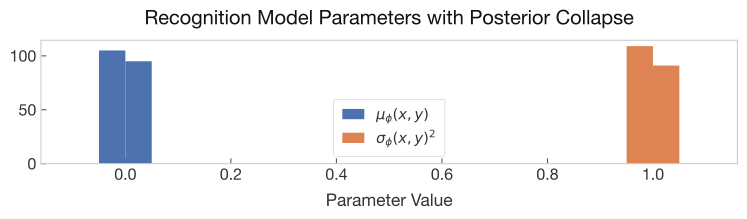 Posterior Collapse: The encoder maps every input to the same distribution,
$\mathcal{N}(0,1)$.
Posterior Collapse: The encoder maps every input to the same distribution,
$\mathcal{N}(0,1)$.
Remember that for the VAE that behaved well in the main results, the latent space plot indicates a fairly uniform distribution of $\mu_\phi(\mathbf{x})$ in a range of roughly $(-2,2)$. Now, every input leads to the same prediction, $\mathcal{N}(0,1)$, which is the very definition of posterior collapse.
Of course, when $\sigma \approx \sigma_{data}$, the decoder assumptions match the true generative process, and the model learns the correct balance between reconstruction and regularization, as the center panel demonstrates.
What if $\sigma$ is Unknown?
The experiments just presented show empirically what happens when $\sigma$ is misspecified — but in a real problem where the true noise is unknown, the approaches below offer more principled alternatives. I present them here for completeness, but they are too complex to squeeze into this single post. There are two scenarios, presented in order of increasing complexity:
Isotropic
If the noise is modeled as isotropic but $\sigma$ is treated as a learnable scalar rather than a function of $z$, we can write $\sigma_\theta(z) \rightarrow \sigma_\theta$. The reconstruction loss is no longer MSE, but we can explicitly differentiate the reconstruction term with respect to $\sigma^2$ and find an analytical expression for the value that minimizes the loss. Starting from equation \ref{eq:reconstruction_loss_sigma} and setting the derivative of $\sigma^2$ to zero:
$$ \begin{equation} \frac{1}{2\sigma^4}\sum_{i=1}^D(x_i - \mu_\phi(z)_i)^2 - \frac{D}{2\sigma^2} = 0 \end{equation} $$leading to the optimal value of $\sigma^2$
$$ \begin{equation} \label{eq:iso_learned_sigma} \sigma^2 = \frac{1}{D}||x - \mu_\theta(z)||^2 \end{equation} $$So we could update $\sigma^2$ in an alternating fashion by taking an optimization step on $\mu_\theta$, and then updating $\sigma$ according to equation \ref{eq:iso_learned_sigma}.
Readers interested in exploring this topic more should check out the paper Taming VAEs by Rezende and Viola.
Anisotropic
In the most general case, the noise levels can differ across input dimensions. A single scalar $\sigma$ is no longer sufficient. In this case, the reconstruction loss takes the form
$$ \begin{equation} \label{eq:aniso_learned_sigma} \log p_\theta(x|z) = -\frac{1}{2}\sum_i\left[ \log(2\pi\sigma^2_i(z)) + \frac{(x_i - \mu_i)^2}{\sigma^2_i} \right] \end{equation} $$where the sum $i$ is over the dimensions of the input. This route adds complexity and can make training more touchy, but in cases where there’s good evidence that the variance is anisotropic and unknown, it may be the best option. I haven’t come across a good reference that discusses how to approach this problem.
Conclusion
In this post we built a VAE from scratch and applied it to a problem where the underlying generative process was fully known. That choice was deliberate — by working with a dataset where we could derive $p(x,y|t)$ analytically, we were able to connect every modeling decision back to first principles rather than treating the architecture as a black box.
The key takeaways are threefold. First, the VAE framework is remarkably general: two Gaussian assumptions and the reparameterization trick are enough to turn an intractable probabilistic inference problem into a differentiable optimization problem. Second, the decoder variance $\sigma$ is not just a tuning knob — it encodes a genuine assumption about the data generating process, and misspecifying it leads to predictable failure modes in both directions. Third, the latent space that emerges from a well-trained VAE genuinely reflects the structure of the data, as the smooth recovery of the spiral parameter $t$ demonstrates.
This post focused on a synthetic dataset where the generative process was fully known, which made it possible to verify the model’s behavior from first principles. The natural next step is to bring these ideas to bear on problems where the latent structure is genuinely unknown — and where imposing additional constraints on the latent dynamics, rather than leaving them unconstrained, can lead to models that are both more interpretable and more physically meaningful.